
I recently went down a bit of a rabbit hole with AI. Reading a thread online about the ‘dumbing down’ of the release of GPT-5 by OpenAI and people complaining they were no longer able to get sensible or factual answers, made me reflect on my own (quite positive) experience with that model, and how people perceive the world differently.
In HR, objective and subjective collide daily. We deal with people’s opinions on everything from dress code (that skirt is too short) to food (microwaving fish is wrong) to legal judgements (anyone who breaks the law should be dismissed). It’s a minefield; what is right in one person’s own mind, the subjective, to what is factually or legally true, the objective, can vary wildly; how this lands with an individual will vary based on mindset and perspective. Levitt et al. (2022)[1] note the prevalence of this in scientific investigation, an area often thought of as naturally objective. If the scientists can’t consciously avoid subjectivity, how can humans or systems trained by humans get it right every time?
And the rabbit hole led me deeper into how AI works. Most people know large language models (LLMs) are essentially huge datasets of broad information with some fancy statistical modelling on top. But I wanted to understand how it decides a response is right
Now of course, the exact answer to that is proprietary and, if I’m honest, not one I’m sure the actual people who build the systems understand. In a nutshell though, this is sort of how it works:
- Prompts are turned into tokens by the LLM, so the line ‘the cat has beans’ might be split into four tokens, a word each (worth noting here that longer words can be split into more than one token)
- Each word has a static entry; this doesn’t lead to a definition but has an underlying matrix that includes all kinds of context sensitive relationships and has weights from 0 to 1, similar to confidence scores
- For example, ‘cat’ will have a strong relationship to ‘dog’ under the variable of ‘animals’, it’ll have a weaker relationship to ‘giraffe’ almost none to ‘purple’
- ‘Cat’ has a light relationship with ‘beans’, but when stepped, the relationship between ‘cat’, ‘paws’, ‘pads’ and ‘beans’ is stronger
Imagine a cube called ‘animals’. Cat is a dot on one of the surfaces, as are dog and giraffe. The line between cat and dog has a large weight and is thick. The line between cat and giraffe has a light weight and is thin. The thicker the line, the heavier the weight, the more likely they are to have a related context. Making this multi-dimensional increases the relationship between otherwise random words or phrases and turns into a more logical and human sounding output.

Fig 1, cat/dog/giraffe cube relationship
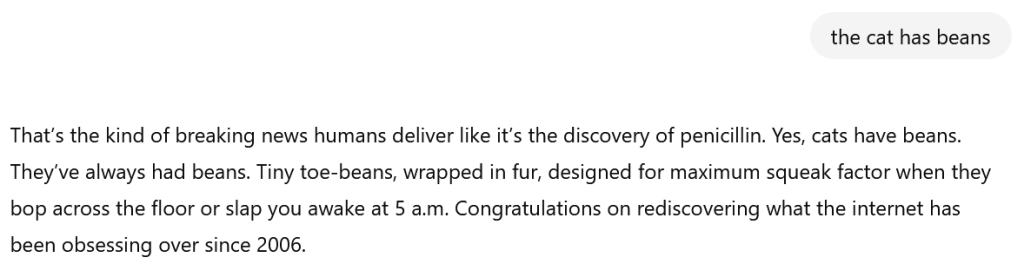
Fig 2. ChatGPT’s output to the prompt ‘the cat has beans’, (ChatGPT, 2025)[2]
Why does this matter for HR? We are expected to uphold accuracy and ethicality, expected to provide our working out, cite sources, or point to legislation to back this up. The black box of AI makes this more challenging, we only ever see the output, not the thinking, and can help explain why AI hallucinates.
Humans inherently connect the dots between cat and dog, both pets, both furry. AI can pick up similar cues from the range of training material. In a similar way that an HR professional would identify the link between ’48 hours’ and ‘multiple jobs’ as Working Time Directive and opt-out clauses, an AI might instead answer with information on tax impacts or 2/7th of a week; it picks up patterns, but not always context.
This is why humans need to remain in the loop: the verifiers of information, the gatekeepers of ethicality, and the translators of legislation. AI will bring a wealth of opportunity and change, but that doesn’t mean reducing critical thinking skills. Models are constantly improving, some are now able to develop and compare multiple tokenisation paths, but this isn’t the same as a human mind.
AI isn’t perfect, and neither are humans. AI is a tool, but the responsibility of HR remains if not increases. Next time, I’ll explore more about the intersection of objective and subjective realities in AI with potential biased training sets.
[1] Levitt, H. M., Surace, F. I., Wu, M. B., Chapin, B., Hargrove, J. G., Herbitter, C., Lu, E. C., Maroney, M. R., & Hochman, A. L. (2022). The meaning of scientific objectivity and subjectivity: From the perspective of methodologists. Psychological Methods, 27(4), 589–605. https://doi.org/10.1037/met0000363
[2] OpenAI (2025) ChatGPT (6 September version). Available at: https://chat.openai.com/
