
We often think about AI use across HR in terms of risk, but are we assuming a one-dimensional approach when we do the maths of ‘AI + HR = Risk’?
I think we are. Risk is an inherent part of the HR process; practitioners often have that little alarm in the back of our heads reminding us to think about both employee and employer risk whenever we interact with a case. If we add AI into the equation, those alarms often end up shrieking loudly.
But, just as with HR in general, I like to consider AI-related risk as dependant on the situation itself, contextualised against the legislative, organisational, social, and cultural environment.
Let’s look at some examples
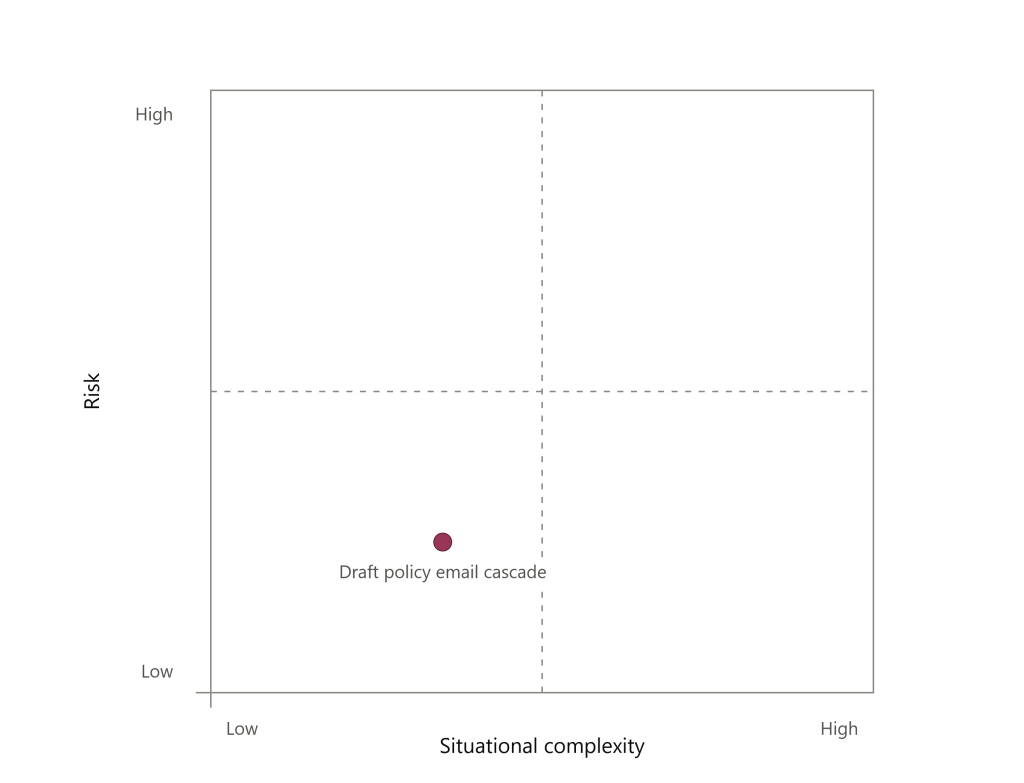
Imagine we need to draft a simple email cascading a new policy. Appears pretty straightforward, mostly just:
“Hi all, here’s a new policy, here’s what it means for you, here’s some examples, speak to X for more info, thanks”
If we judge it on a risk vs situational complexity matrix, we’d end up pretty low in the bottom left:
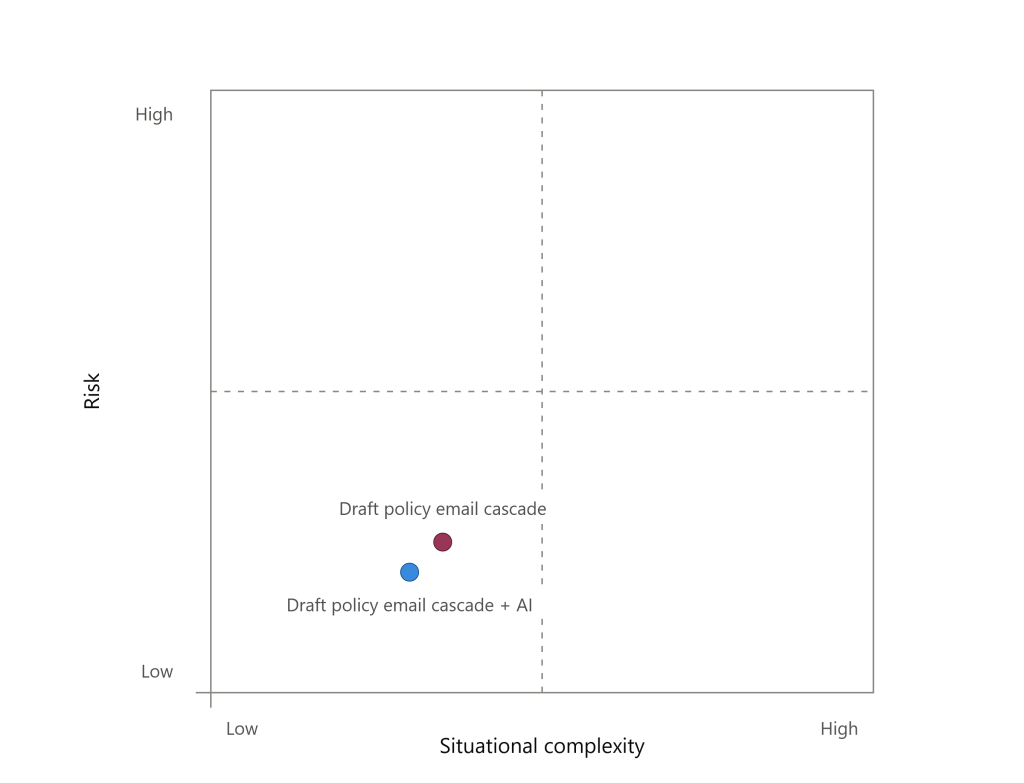
Now, let’s imagine drafting that email with AI; does it change the risk? Does it change the complexity?
It’s possible to imagine that risk might go down; after all, AI could provide more detailed and accurate email copy with direct references to the policy itself. We might also see situational complexity reduce, as targeted copy might help put policy examples in language the audience may better understand. Now our risk matrix shows a reduction from the red dot to the blue:
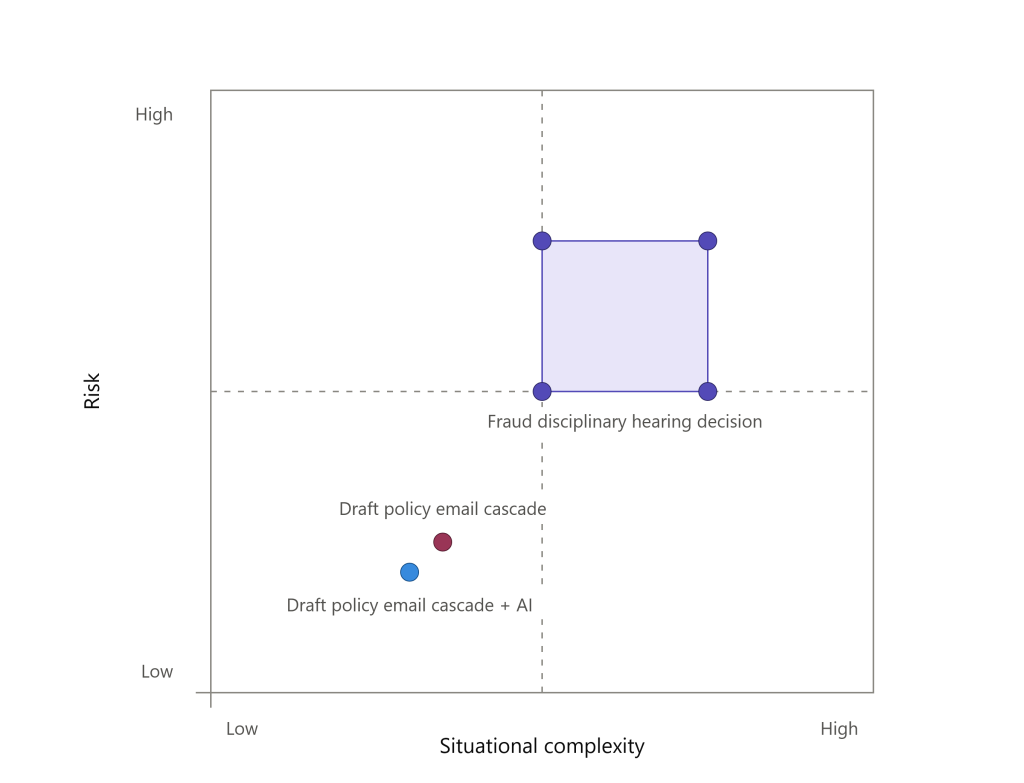
But what about something a bit more complex? How about identifying if an employee should be taken through a disciplinary hearing for alleged fraud.
An experienced HR practitioner would recruit an independent investigator and/or hearing manager, help gather the relevant information, build a timeline, support witness statement gathering, provide guidance on safe legal and ethical HR practice to the manager, and many other things.
If there is strong evidence, it might point to a potential gross misconduct case to answer. But it’s highly contextually sensitive. What if there are mitigating circumstances? What if the employee is a victim of domestic abuse being forced to steal for a partner? What if they thought they were following the process and were never formally trained. What about…. the list goes on.
This contextualisation creates quite a broad risk matrix:
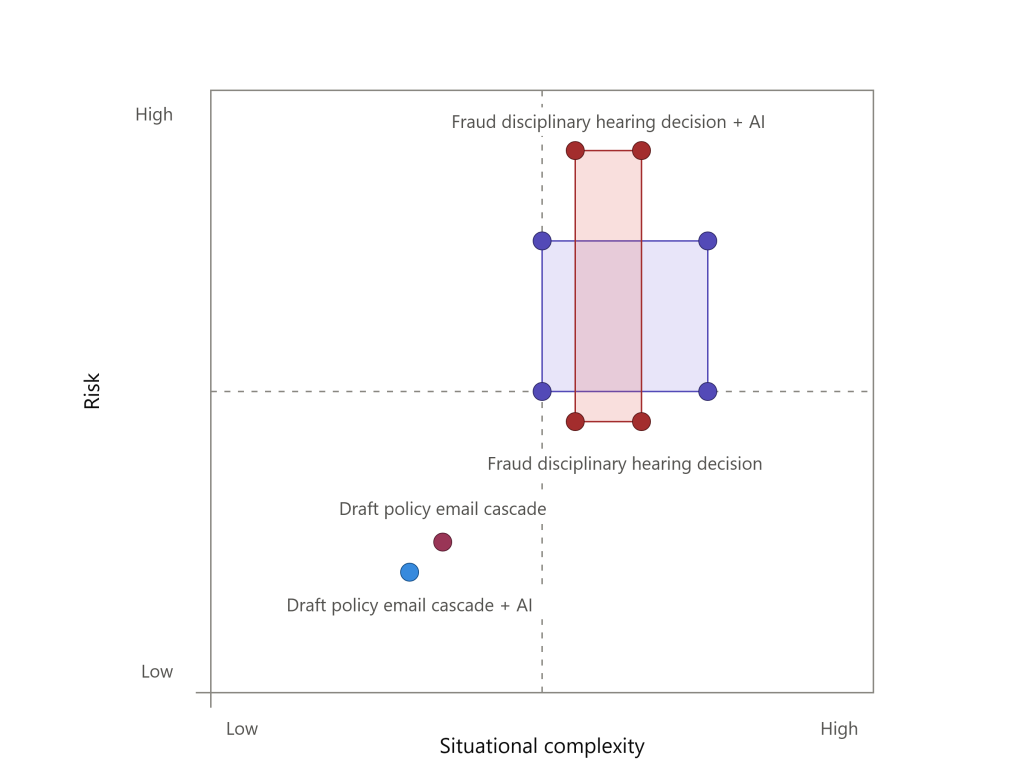
Now we add AI into the equation, asking it to act as the investigation/hearing manager and to make or suggest a decision. Does the risk increase or decrease? Does the complexity change?
There is no correct answer here, but lets make some assumptions. AI is less likely to have a contextualised understanding of the situation, so it may operate with a more narrow lens. Conversely, risk may increase; with a shallower contextual understanding, the chance of taking inappropriate action rises. The matrix now has a narrower but taller section:
So what does this tell us? Well, not a huge amount. AI can be helpful. AI can be risky. AI can handle some actions and not others. Does that make humans right and AI wrong? To make informed decisions on when and how to use AI, we need to add further dimensions.
Risk doesn’t stand alone; we need more variables
We’ve already got risk and complexity, but no clear understanding of where AI or human ownership overlaps or interacts, or an appreciation of the rules-bound state of the situation itself.
To make sure we’re comparing apples to apples, we need to define what we’re measuring and how they interact.
Kind : Wicked
Building on the work of Hogarth et al. (2015), we can apply a rules-bound state to a HR situation.
Kind is a stable, rules-based task; Wicked is high variability in interpretation. Chess can be considered to be in a Kind state: it is rules-bound, has a transparent current-state, and is unambiguous in it’s output. Poker is Wicked: moves may be defined, but bluffing and subterfuge mean even a perfect hand can lose.
Applied to HR, we can consider an employees annual leave entitlement to be Kind, we know what they are entitled to, what they’ve used, what is booked for the future, and therefore their remaining allowance is calculable.
EAT case law would fall to the Wicked end. The case-specific decision is fixed, but the interpretation is often highly subjective, and we cannot reliably guarantee that our understanding will match that of the presiding judge.
Simple : Complex
Simple versus complex is more straightforward. Simple is low complexity in outputs; Complex is high complexity in outputs.
A Simple case might be whether someone is entitled to paid overtime. If they worked the time, have a right to be paid for that at a certain rate, and this is agreed by appropriate management, the calculation is simple and open to limited interpretation.
A Complex case, well, that’s the bread and butter of ER! A multi-person grievance, with overlapping arguments, including trade union reps and senior leaders, and interpretation of contract provisions, is likely to be at the complex end.
AI : Human
Finally, we can look at where ownership should land. AI is suited to routine delivery; Human shows human insight is core.
We’ve already plotted that AI is likely to be quite suitable for a basic policy email cascade; conversely, we are highly unlikely to ever want AI to make a disciplinary decision!
Just a quick aside on that, GDPR Article 22 pretty much prohibits solely automated decision making where a human isn’t consulted – I’ll be doing a future post on Human-in-the-Loop and the legislation that really matters in the AI HR space.
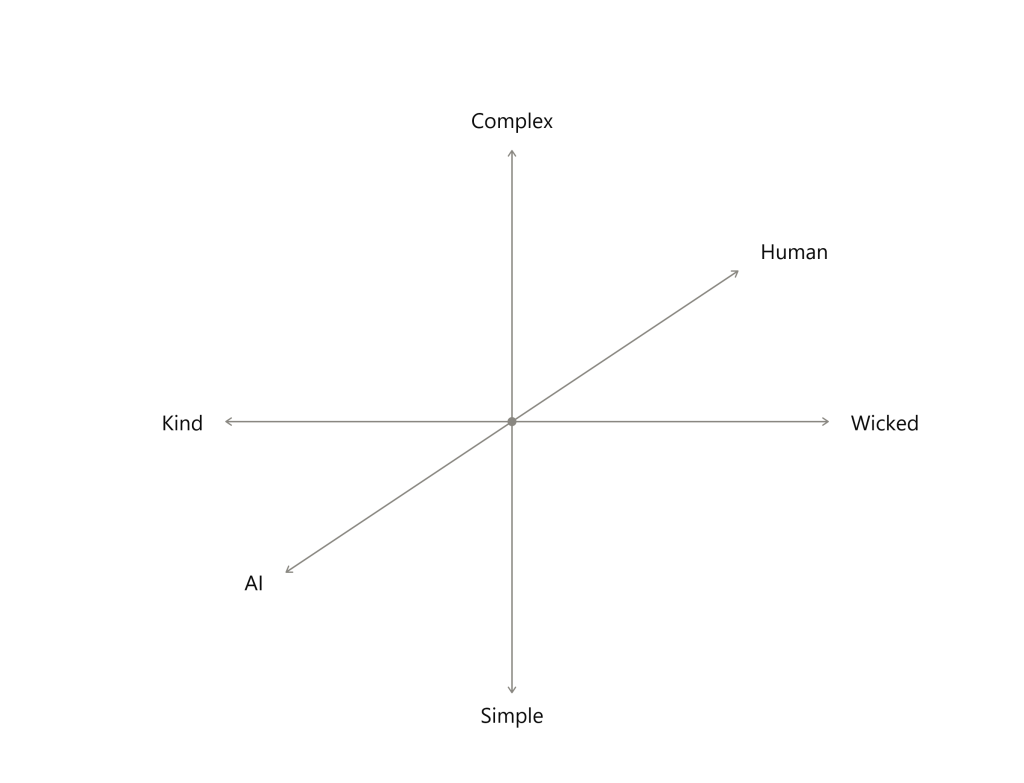
The Three-Axes Framework
The Three-Axes Framework (Grice-Lloyd, D, 2026) lets us plot these three axes against each other, developing a tool that can support decision making in the HR AI space. With the three axes identified, we can visualise a cube with 8 inner octants, one per intersection of the three axes:
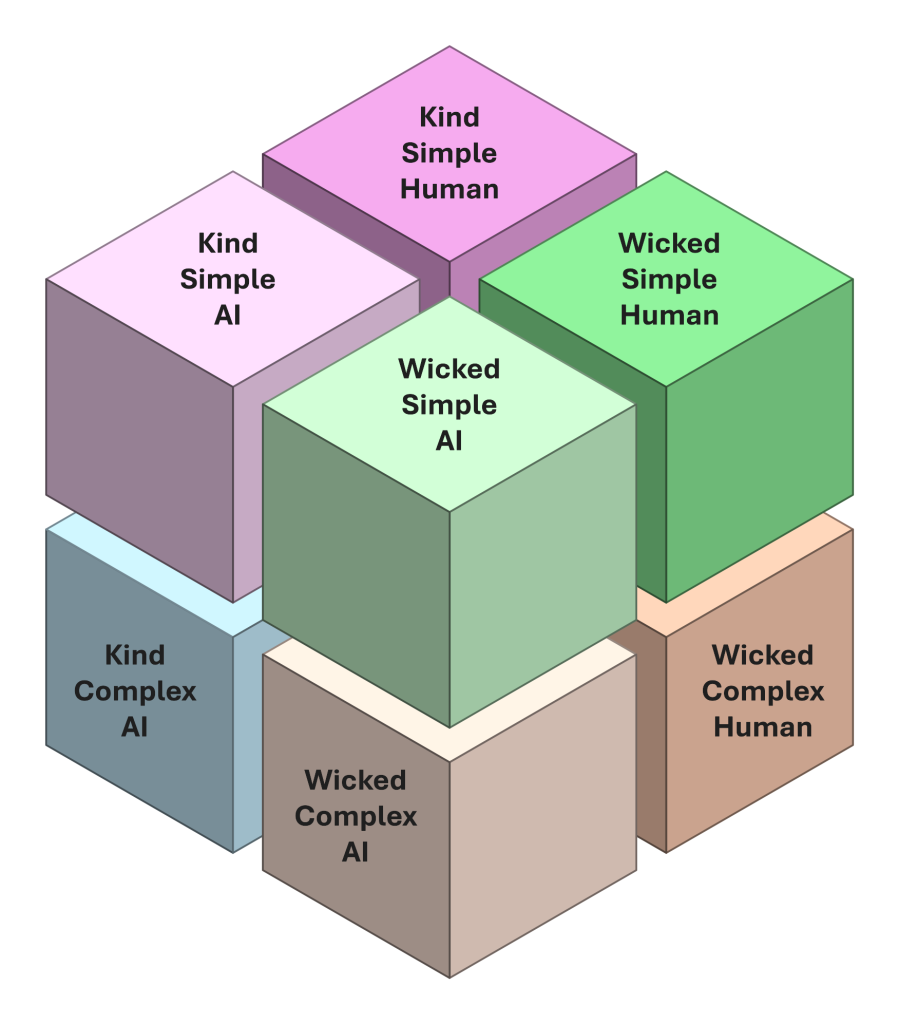
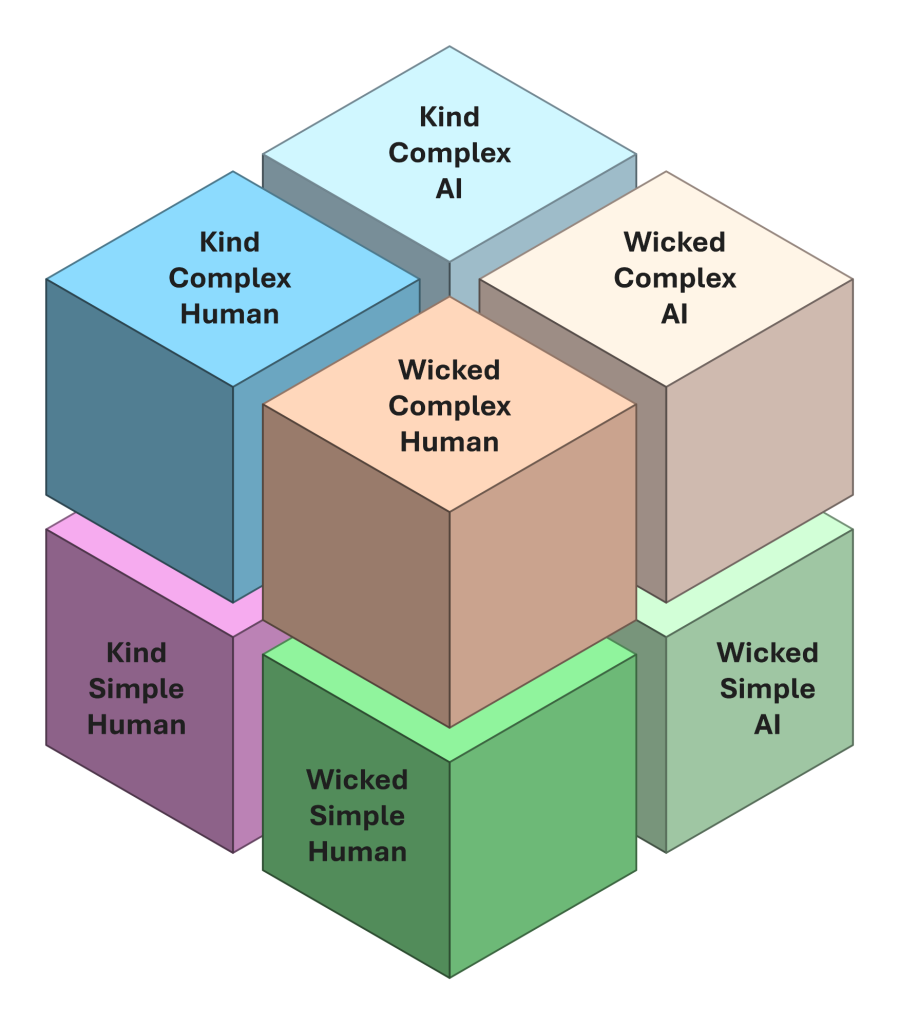
You can use the cube to overlay situations against those three-axes to help inform your decision making.
Think of a Kind, Simple, AI situation. We could easily see AI answering a basic annual leave query; it’s a low risk query with a transparent current-state, and a well setup AI agent or system could retrieve this from a HCM system.
Now think of a Wicked, Complex, Human situation. We are highly unlikely to ask AI to provide suggestions on relevant actions in the complex grievance described earlier; it’s the sort of case where we would almost always have a highly experienced senior HR practitioner acting as the HR support. Handing off total control to AI is like handing it off to a HR Advisor with just a weeks experience; a technically correct answer might be provided, but understanding of the ‘gray’ of HR is likely to be missing.
Of course, not all Kind Simple situations will be AI appropriate. And even Wicked Complex situations may find AI to be a useful partner in collation or verification.
I’ve created an interactive 3D render of this model, you can access it by following this link https://dangl0.github.io/Three-axis-Framework-3d-Render. I’ve also embedded the demo page below, showing you how the cube changes as you adjust the axes sliders:
The Three-Axes Framework is not empirically validated and is provided as a conceptual visualisation tool only. As with all things HR, especially AI, the ultimate accountability always rests with the HR practitioner or user. It’s available for use under CC BY 4.0, which just means attribute it using:
Inline ref: Grice-Lloyd, D (2026)
Full ref: Grice-Lloyd, D. (2026). Accountability in action: Exploring ethical and legal risks in AI-supported employee relations in the UK railway industry. OSF Preprints. https://doi.org/10.31235/osf.io/h42ef_v1
The key: proportionality
We often think of proportionality as one of the bedrocks of ethical HR practice. In reality, it can end up as a talking point with limited evidence of active delivery.
But if we utilise the three-axes, proportionality stops being a pretty assurance phrase and starts being something we can actually use operationally. Using the tool well requires a reasoned understanding of where a situation sits on the axes, and this naturally results in a stronger appreciation of the nuances and the risks.
With each axis able to act as an independent starting point into the framework, we can use that to identify where the other two logically align, resulting in clear identification of risk, complexity, and ownership.
It therefore holds that, through a thorough understanding of where a situation sits on the axes, the ability to articulate the ‘why’ becomes much easier. A stronger why will support the decision-making process, and reduce overall case-risk.
Remember, AI is a tool, the human is always accountable
As we dive into this AI-enabled HR and ER world, we must always remember that HR is primarily a human function. We are here to support, coach, develop, occasionally reprimand, and encourage colleagues.
AI is an enabling technology; it is not a replacement for us. After all, AI can take some of the admin off us and let us focus on value-add activity, but no computer can (yet!) sit with a colleague and be that safe listening ear for a complex, challenging, highly-personal issue. And that’s the stuff that makes HR a worthwhile career.

